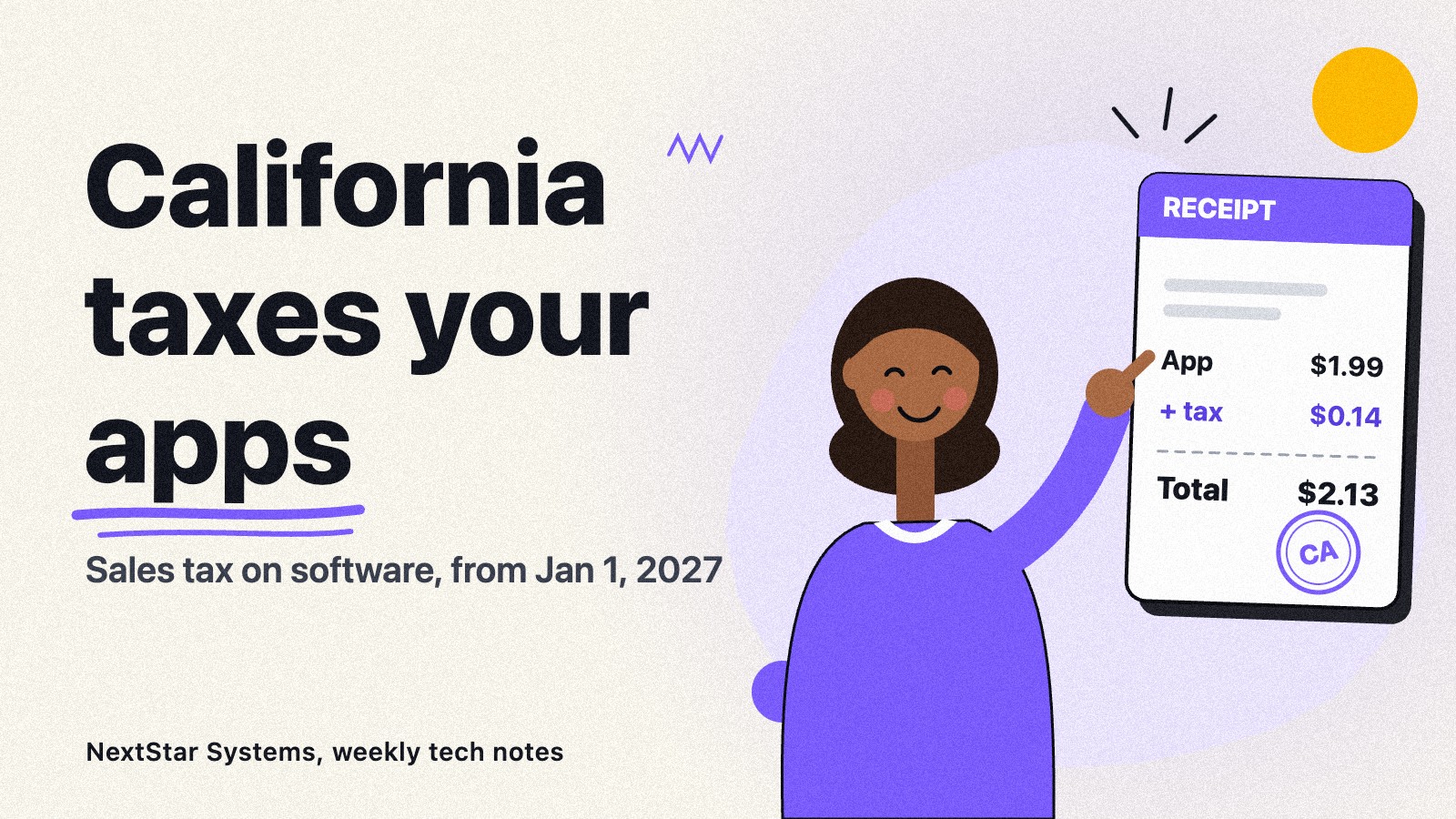
California app store sales tax starts on January 1, 2027, when a new state law called SB 122 puts sales tax on prewritten software and SaaS for the first time. Apple confirmed on November 17, 2026 that apps in five of its tax categories will be taxed in California, and since US prices are shown before tax, the total Californians pay at checkout may go up while the price tag stays exactly the same.
Most of the coverage I saw folded this into a roundup of exchange-rate tweaks in other countries. Fair enough, Apple buried it there too. But it’s the biggest US tax change for apps in a long time, and the list of what gets taxed has an odd hole in it.
Your to-do app gets taxed. Your game doesn’t.
What Apple told developers on November 17
The note sits on Apple’s developer news page under a dull title, “Tax and price updates for apps, In-App Purchases, and subscriptions”. Most of it is routine stuff: new VAT in Botswana and Rwanda, a new digital tax in Cameroon and Ivory Coast, and automatic price changes in five storefronts on December 3.
Then there’s the California paragraph. From January 1, 2027, apps in the SaaS, App Store Software, Software Training Material, Dating and Boosting categories become subject to California sales and use tax. (Yes, Boosting is a real App Store tax category.) Apple also added a new SaaS attribute that developers can set in App Store Connect, under Pricing and Availability.
Two lines in that note matter for anyone holding a phone. Apple says prices on the US storefront are “displayed to customers exclusive of taxes”, so what you see on the product page won’t move. And it says the total customers are charged, tax included, may increase. Developers’ proceeds don’t change. So the whole thing lands on the buyer, which is how US sales tax always works, just on a purchase most people never thought of as taxable. 9to5Mac picked it up the same day, as one item in a list.
Which apps California app store sales tax covers, and which it skips
What the new law taxes
SB 122 was a budget trailer bill, signed by Governor Gavin Newsom on June 29, 2026, according to Holland & Knight’s write-up. It widens California’s definition of tangible personal property so it also covers a “digital product”, which the bill defines as prewritten software, whether it comes on a disc, as a download, or runs remotely. Avalara’s summary has the full wording if you enjoy that sort of thing. In plain terms, software made for general sale is now taxable however it reaches you. Fully custom software stays exempt.
For three decades California basically taxed software in a box and left software from a server alone. That line is gone now, and the state’s tax agency, the CDTFA, has already put up a tax guide for retailers and buyers of digital products and is drafting emergency rules to go with it.
What it leaves out
The bill carves out a list of digital things that stay untaxed: digital video games, digital books, music and other audio, video and streamed media, crypto assets, and the cloud infrastructure developers rent to run their own code. Apple’s category list lines up with that. Games aren’t on it. Neither are books or music.
| On your phone | Taxed in California from January 1, 2027? |
|---|---|
| Productivity and utility apps (App Store Software) | Yes |
| Subscriptions to SaaS-style apps | Yes |
| Dating apps and boosts | Yes |
| Games | No, digital video games are excluded |
| Ebooks, music, video and streaming | No, excluded by SB 122 |
I get the logic on paper. Those were never “software” in the sense the bill means. But look at it from the App Store. A $4.99 puzzle game is tax-free and a $4.99 habit tracker isn’t. A streaming subscription is tax-free and a note-taking subscription isn’t. It’s a line that makes sense to a tax lawyer and very little sense to someone scrolling through apps on a Sunday night.
What a $1.99 app and a $9.99 subscription will really cost
California’s statewide base rate is 7.25%, and local district taxes push it to about 10.75% in some places, depending on the buyer’s address. SaaStr ran those numbers for business software and called it 8 to 10% for most buyers.
On a $1.99 app, that’s somewhere between 14 and 21 cents, once. Nobody’s going to cancel over that.
A $9.99 monthly subscription is a different story. That’s 72 cents to about $1.07 extra every month, or roughly $8.70 to $12.90 a year, for one app. Keep five subscriptions like that and the tax alone comes to somewhere around $43 to $64 a year. And because the US App Store shows prices before tax, you won’t see any of it on the product page. You’ll see it on the receipt.
There’s one more wrinkle. For sales that don’t happen in person, the law points first to the buyer’s billing address in the seller’s records. Tax people have already pushed back on that, since a billing address doesn’t always say where you actually use the software. How Apple maps that rule onto your Apple Account, the note doesn’t say.
How to check what you’ll pay before January
None of this needs action today, but five minutes now beats a surprise on your first January receipt.
- Check your billing address. On iPhone, open Settings, tap your name, then Payment & Shipping. California’s law looks at the billing address first.
- List your subscriptions. In Settings, tap your name, then Subscriptions. Each monthly price there is the number the tax will sit on.
- Cancel what you don’t use. If you haven’t opened an app in a month, this is a good excuse. Our guide to cancelling hard-to-quit services covers the stubborn ones.
- Read your first January receipt. The tax line shows up on the receipt Apple sends, not on the store page.
- If you sell apps, open App Store Connect. Check your tax category and the new SaaS attribute under Pricing and Availability before January 1.
Pay once, get taxed once
I’ll admit some bias here. We build small iPhone, iPad and Mac apps and sell them once, with no account and no ads. A one-time purchase gets taxed one time. A subscription gets taxed every single month for as long as you keep it, which is one more quiet reason I think pay-once is kinder to the person paying. (I made a similar point when Apple shut down its own Support Community last week, from a different angle.)
Mymembership is a good example. It’s a $1.99 app for iPhone and iPad that tracks class packs and gym memberships, how many classes you have left and what each class really costs you. Even at the top local rate, the tax on it is a couple of dimes, paid once.
And if you build WordPress sites on a Mac, PlugBench runs a local server for testing plugins without Docker. It’s free for three sites, and Pro is $29 once. There’s no monthly line on your statement for a new tax to grow on.
Frequently asked questions
Will iPhone apps cost more in California in 2027?
Many will, at checkout. From January 1, 2027, Apple will apply California sales and use tax to apps in the SaaS, App Store Software, Software Training Material, Dating and Boosting categories. The price shown on the US App Store doesn’t include tax, so the listed price stays the same, but the total you’re charged can go up.
Are mobile games taxed under California SB 122?
No. SB 122 excludes digital video games from the digital products it taxes, and games aren’t among the App Store categories Apple listed. Digital books, music, video and streamed media are excluded too.
How much is the California sales tax on an app?
It depends on the buyer’s address. The statewide base rate is 7.25%, and local district taxes can push the total to about 10.75%. On a $1.99 app that’s roughly 14 to 21 cents, and on a $9.99 monthly subscription about 72 cents to $1.07 a month.
Do app developers earn less because of the California tax?
No, according to Apple. Its November 17, 2026 note says developers’ proceeds won’t change, because the tax is added on top of the US price. The buyer pays it.
Sources:
- Tax and price updates for apps, In-App Purchases, and subscriptions, Apple Developer
- Tax Guide for Retailers and Purchasers of Digital Products, California Department of Tax and Fee Administration
- The Party’s Over: After More Than Three Decades, California Will Begin Taxing SaaS, Holland & Knight
- California to tax software and SaaS in 2027, Avalara
- California Is Taxing SaaS and AI Tools and Is About to Make Your Software 8-10% More Expensive, SaaStr
- Apple announces App Store price changes in multiple countries, new California tax rules, 9to5Mac
Xavier Reiss, co-founder of NextStar Systems. We build small pay-once apps for iPhone, iPad and Mac.